
See Comet A3 Tonight: Here’s How
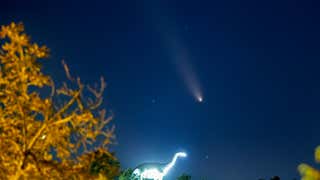
- Now is your chance to see comet A3.
- Look to the west after sunset.
- Dark, clear skies will help you get the best view of the comet.
Now is your once-in-a-lifetime chance to view one spectacular comet soaring across the night sky.
Comet Tsuchinshan-Atlas, also known as comet A3, is potentially visible across the U.S. through Oct. 24. But it will dim as the month goes on and it moves farther away from the sun and higher in the sky.
Your chances for a good view depend, of course, on the weather.
How To Find The Comet:
-Have as clear a view of the western horizon as you can.
-Look in that direction starting about 15 minutes after sunset through about 45 minutes after, depending on your exact location. The comet will be fairly low on the horizon.
-Binoculars or a small telescope will help, as will keeping your eyes away from light to maintain your night vision.
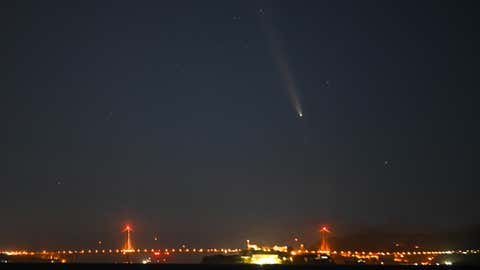
Comet Tsuchinshan-Atlas, the C/2023 A3 Tsuchinshan-Atlas comet, is captured over the Golden Gate Bridge in San Francisco on Sunday, Oct. 14, 2024.
(Photo by Tayfun Coskun/Anadolu via Getty Images)
Weather.com senior meteorologist Dina Knightly adds:
– Light from the setting sun may highlight the comet, making it easier to see.
-Many of us in the United States have a good chance to see it tonight as the cloud cover won’t be bad.
-Set a reminder to check after sunset in the western sky.
Why This Is Such A Big Deal:
-Comet A3 won’t enter the inner solar system again for another 80,000 years, if ever.
-Scientists thought the comet might break up during its closest pass to the sun on Sept. 27. NASA astronomer Bill Cooke says: “Comets are more fragile than people may realize, thanks to the effects of passing close to the sun on their internal water ice, and volatiles such as carbon monoxide and carbon dioxide.”
-NASA says the comet could eventually be flung out of our universe like a pebble from a slingshot, thanks to “the gravitational influence of other worlds and a ‘jetting’ effect caused by the comet’s offgassing during its solar transit.”
MORE AT WEATHER.COM
–‘The Aurora Guy’ Follows His Passion To Chase The Northern Lights
–The 2024 Total Eclipse, In Photos
-And The Astronomy Photo Of The Year Is …
Weather.com reporter Jan Childs covers breaking news and features related to weather, space, climate change, the environment and everything in between.
Source link