
Hurricane Oscar makes landfall in the Bahamas, heads toward Cuba
Hurricane Oscar made landfall early Sunday in the southeastern Bahamas and was heading toward Cuba, where it was forecast to make a second landfall in the afternoon, the National Hurricane Center said. The storm was expected to strike Cuba along the northern coast of the island’s Guantanamo and Holguin provinces.
Oscar, which the hurricane center characterized as “very small,” is the 15th named storm of the hurricane season. It formed as a tropical storm just east of the Turks and Caicos islands on Saturday before quickly becoming a hurricane.
It was just off the coast of Great Inagua in the Bahamas early Sunday and maintained a steady strength through the morning on its path to Cuba. It was forecast to hit the Bahamas again on Tuesday but at a different point in the island chain.
Forecasters said hurricane conditions were continuing in portions of the southeastern Bahamas at 11 a.m. Eastern Time on Sunday.
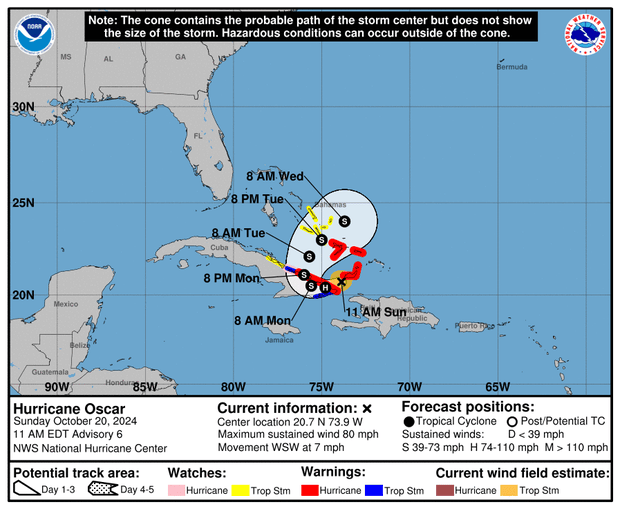
NOAA/National Hurricane Center
Rainfall amounts of 5 to 10 inches — and potentially up to 15 inches in some places — were expected in eastern Cuba through Tuesday, the hurricane center reported, with 3 to 5 inches expected in the southeastern Bahamas. Another 2 to 4 inches of rainfall was expected across the Turks and Caicos through Wednesday morning.
The governments of the Bahamas and Cuba issued hurricane warnings for the southeastern Bahamas and the north coast of the Cuban provinces of Holguin and Guantanamo to Punta Maisi. The government of Cuba has also issued a hurricane watch for the north coast of the province of Las Tunas.
Oscar was forecast to weaken after landfall in Cuba, but it could still be a tropical storm when it moves north of the island Monday night on a path set to take it across the central Bahamas.
The storm’s maximum sustained winds were still clocked at 80 mph as of 11 a.m. Eastern Time on Sunday. Its center was located about 55 miles west-southwest of Great Inagua Island and about 90 miles east-northeast of Guantanamo, moving west-southwest at 11 mph. Hurricane-force winds extended outward up to 10 miles from the storm’s center.

NOAA/NESDIS/STAR GOES-East
The Atlantic hurricane season officially began on June 1 and finishes Nov. 30, with most activity occurring between mid-August and mid-October. Hurricane activity tends to peak in mid-September, according to the National Oceanic and Atmospheric Administration.
In Florida, Gulf Coast communities are struggling in the wake of back-to-back hurricanes, as Hurricane Helene rammed into the region less than two weeks before Hurricane Milton arrived.
Source link