
James Webb Telescope Locates the First-Ever ‘Einstein Zig-Zag’, a Potential Key to Saving Cosmology
The James Webb Space Telescope (JWST) has achieved a groundbreaking discovery, revealing the first-ever instance of an “Einstein zig-zag“. This previously theoretical phenomenon involves light bending and swerving through two distinct regions of warped space-time, creating a dazzling, multi-image display. The find isn’t just visually stunning—it could potentially unlock secrets that might “save” modern cosmology.
The Birth of the Einstein Zig-Zag
In 2018, astronomers observed an extraordinary cosmic spectacle: four identical bright points in the depths of space. Named J1721+8842, these lights were initially thought to be mirror images of a single quasar, duplicated by a process called gravitational lensing. This phenomenon bends light around massive objects, forming multiple images or halos, like the well-known Einstein rings.
New studies, however, revealed two additional points of light and a faint red Einstein ring. With fresh insights from JWST, researchers determined that all six light points originate from a single quasar. The light’s journey through two gravitational lenses created an unprecedented zig-zag pattern, reshaping our understanding of space-time distortions.
- Gravitational lensing process: The light first passed through a nearby galaxy cluster, creating four mirror images, and then through a second more distant lens, forming additional duplicates and the faint Einstein ring.
- Observation instruments: JWST’s Near Infrared Camera (NIRCam) provided high-resolution imaging that enabled the detection of faint duplicates and the red Einstein ring.
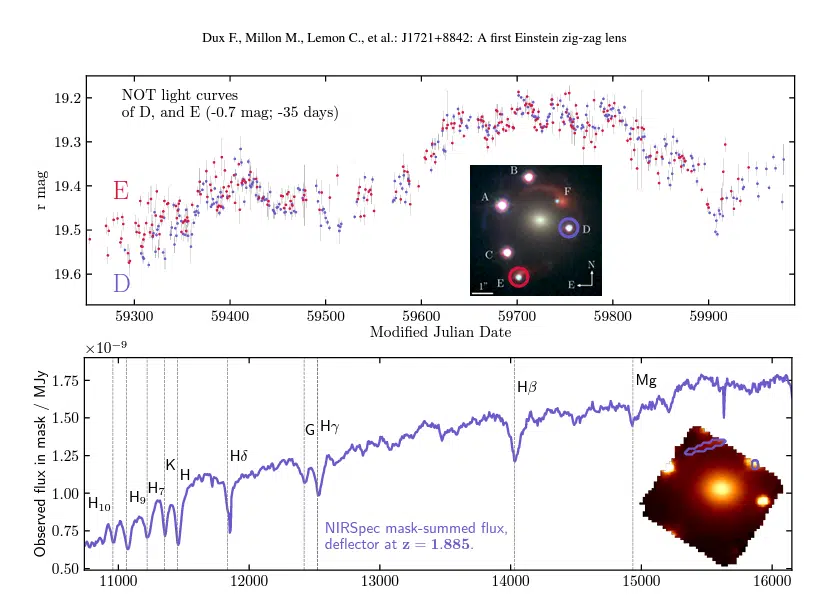
Bottom: JWST/NIRSpec spectrum of the far deflector arced by the foreground lens. The spectrum was extracted from the mask drawn on the inset, which itself is a single slice of the NIRSpec cube. The redshift was determined from the overlaid absorption lines. Note that the total flux presented here is not corrected for the magnification due to the lensing.
Can the Einstein Zig-Zag Resolve the Hubble Tension?
Gravitational lensing is more than a stunning visual display—it’s a cosmic yardstick. By examining warped light, scientists can measure the mass of galaxies, probe the enigmatic dark matter, and calculate the Hubble constant, the metric for the universe’s expansion rate. Yet, JWST’s advanced observations have unearthed a troubling riddle: regions of the universe appear to expand at inconsistent rates, a dilemma known as Hubble tension.
The Einstein zig-zag might be a game-changer. Its intricate configuration enables astronomers to simultaneously refine measurements of dark energy—the mysterious force driving cosmic expansion—and the Hubble constant, offering a rare chance to address this cosmological conundrum.
Why Patience Is Key for This Breakthrough
While the discovery of the Einstein zig-zag is a triumph, its true potential lies in the details. Precise calculations require painstaking analysis of the warped light’s paths, a process that could take years. Dr. Thomas Collett, an astrophysicist, notes that resolving these figures could confirm or challenge existing cosmological models, reshaping our understanding of the universe.
For now, the Einstein zig-zag stands as a beacon of possibility—a rare and remarkable phenomenon that bridges the gap between the known and the unknown in the vast expanse of space. This cosmic zig-zag might not just illuminate the mysteries of our universe; it could redefine them entirely.
Source link