
This Galaxy’s Mysterious Warped Disk Has Astronomers Puzzled – Here’s What Hubble Saw
The NASA/ESA Hubble Space Telescope has captured an extraordinary edge-on view of the spiral galaxy UGC 10043, a rare perspective that highlights the unique structure of this cosmic marvel. Located approximately 150 million light-years away in the constellation Serpens, UGC 10043’s image offers astronomers an opportunity to examine details often obscured in face-on observations of spiral galaxies.
The photograph not only showcases Hubble’s enduring capabilities but also reveals the intricate dynamics of this galaxy, including its prominent dust lanes, glowing central bulge, and an unusual warped disk.
A Rare Edge-on View of a Spiral Galaxy
Unlike the traditional face-on views of spiral galaxies, UGC 10043 is seen from its edge, making the disk appear as a sharp line across the cosmos. Dark bands of dust lanes obscure much of the galaxy’s glow, while bright regions of active star formation pierce through the veil. These active regions are critical areas where gas and dust collapse to form new stars, adding to the galaxy’s ongoing evolution.
One of the most striking features of UGC 10043 is its central bulge, a glowing, egg-shaped region extending above and below the disk. While bulges are a common component of spiral galaxies, the one in UGC 10043 is unusually large. Astronomers believe this may result from gravitational interactions with a nearby dwarf galaxy, which could have transferred material to the bulge and shaped its unusual size.
This past interaction is also suspected to have caused the galaxy’s warped appearance, with the disk bending upwards on one side and downwards on the other—a detail that sets it apart from many other spiral galaxies.
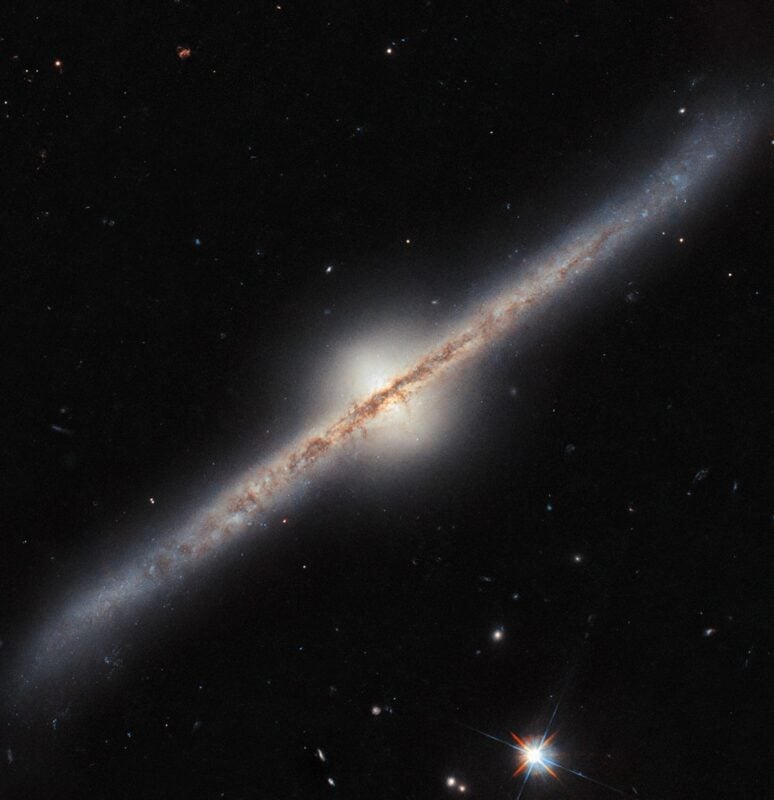
ESA/Hubble & NASA, R. Windhorst, W. Keel.
Hubble’s Timeless Contributions to Astronomy
This image of UGC 10043 is a composite created from data collected 23 years apart, in 2000 and 2023. Hubble’s ability to return to the same celestial targets over decades is one of its most remarkable features, allowing scientists to refine their observations and create a long-term archive of astronomical data. This longevity also showcases how advanced technology from the 1990s continues to yield groundbreaking insights today.
By combining observations across multiple wavelengths of light, Hubble provides a more complete picture of galaxies like UGC 10043, revealing layers of complexity that would otherwise remain hidden. Such discoveries not only expand our understanding of galactic evolution but also emphasize the importance of long-term investments in space exploration.
The edge-on view of UGC 10043 is more than a stunning visual—it’s a window into the forces that shape galaxies and the universe as a whole. With the Hubble Space Telescope still delivering unparalleled images, the mysteries of the cosmos continue to unfold, inspiring further exploration and discovery.
Source: https://science.nasa.gov/missions/hubble/hubble-captures-an-edge-on-spiral-with-curve-appeal/
Source link