
Scientists Warn of a Supervolcano Awakening That Could Trigger Global Chaos
The Phlegraean Fields, a sprawling supervolcano near Naples, Italy, is showing troubling signs of reawakening. The Solfatara crater, one of its most active sites, has been steadily releasing more gas since 2005, catching the attention of both scientists and locals. With carbon dioxide emissions equivalent to burning 500,000 gallons (2,273.05 m³) of gasoline daily, the region is emitting signals that demand serious attention.
Gas Emissions Are Skyrocketing: Why It Matters
Research led by Gianmarco Buono of the Italian National Institute of Geophysics and Volcanology highlights the disturbing spike in emissions from the Solfatara crater. Between 4,000 and 5,000 tons of carbon dioxide escape each day, and up to 80% of this comes directly from magma beneath the surface. The rest is attributed to reactions between hot underground fluids and calcite-rich rocks. This surge in activity has scientists racing to understand whether the magma is inching closer to the surface.
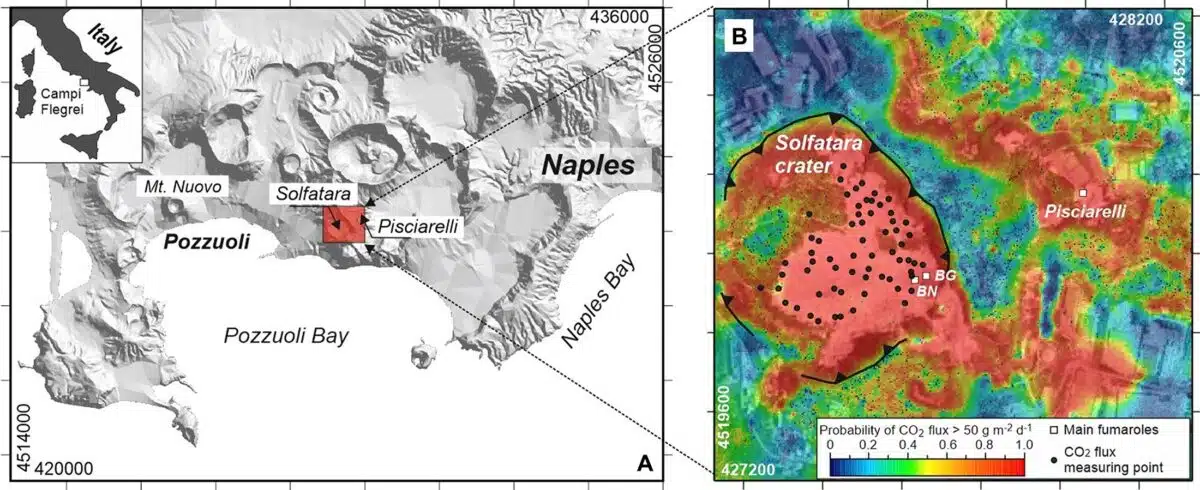
(B) Map of diffuse degassing structure at the Solfatara-Pisciarelli hydrothermal site (after Cardellini et al., 2003). Coordinates are expressed in UTM-WGS84.
What Makes a Supervolcano So Dangerous?
Supervolcanoes like the Phlegraean Fields can unleash eruptions thousands of times more powerful than standard volcanic events. The resulting ash clouds and gases could blanket the globe, triggering catastrophic climate disruptions. The Phlegraean Fields’ history includes a devastating eruption 40,000 years ago, marking it as a geological time bomb.
Moreover, the region has seen not just gas emissions, but also tremors and noticeable ground deformation, hinting at underground changes. These signs align with heightened activity levels recorded since 2005. In 2012, authorities raised the volcanic alert from green to yellow, signaling an elevated threat level.

Are We Prepared for What’s Coming?
Experts emphasize the need to distinguish between gas emissions caused by magma movement and those from natural rock interactions. This critical distinction could mean the difference between a false alarm and a life-saving evacuation.
The Phlegraean Fields remind us of Earth’s volatile nature. While not every sign of activity leads to disaster, the stakes are high, and the world is watching. Could we be nearing another catastrophic eruption, or will the volatile crater settle down? Only time will tell, but the clock is ticking.
The full study was published in the journal Geology.
Source link