
Earth’s Core Is “Leaking” Iron
Imagine if the Earth beneath our feet was not the solid, unchanging rock we thought it was. A recent groundbreaking study has revealed something truly surprising: Earth’s core may be leaking iron into the mantle. This discovery, which is backed by a 2020 study in Nature Geoscience, could completely change our understanding of the planet’s inner workings, revealing a far more dynamic Earth than we ever imagined.
Deep beneath the surface, the Earth’s core is composed of a solid ball of metal surrounded by a swirling mass of liquid iron and nickel. But new research suggests that these molten metals don’t just stay put—they might be migrating, moving into the rocky mantle below. The study shows how iron isotopes could be shifting across Earth’s interior in a way scientists never expected. This could have profound implications for the behavior of the planet over geological timescales.
The Iron Leak: How It Was Discovered
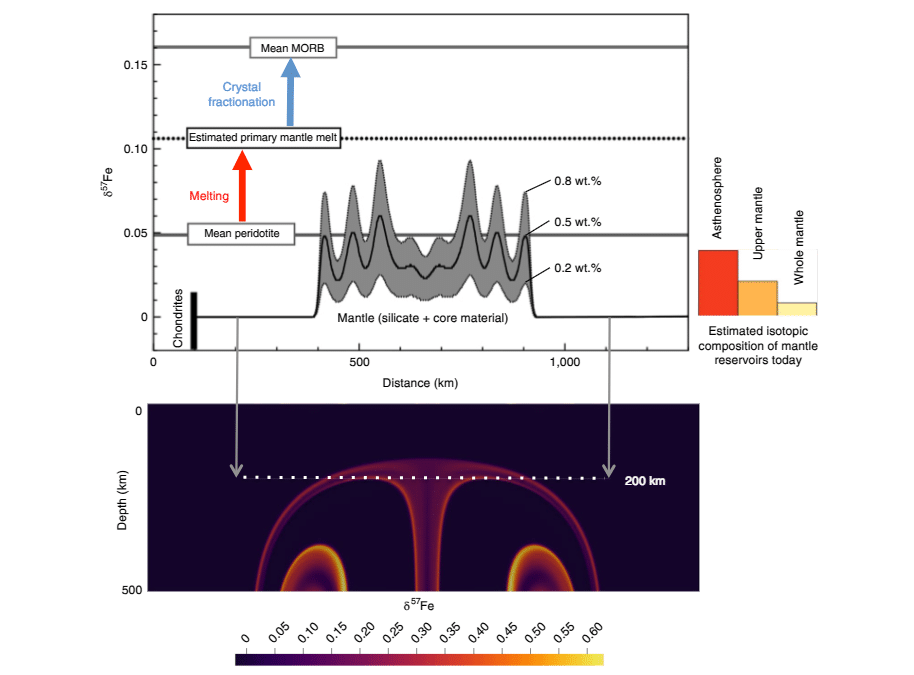
Researchers reached their surprising conclusion through high-pressure experiments and complex geodynamic modeling. By simulating conditions at temperatures over 2,000 °C (3,632 °F) and extreme pressures, they observed how iron behaves under conditions that mimic the Earth’s inner layers. The study found that temperature gradients could cause heavier iron isotopes to migrate toward cooler regions, pushing some of the core’s iron into the mantle.
As Charles Lesher, lead author of the 2020 study and professor emeritus of geology at UC Davis, stated: “If true, the results suggest iron from the core has been leaking into the mantle for billions of years.” This phenomenon could explain why metallic material from Earth’s core has been seeping into the mantle for billions of years. Scientists had long speculated about the possibility of material transfer between Earth’s layers, but this discovery provides the first concrete evidence that such processes may indeed be occurring on a massive scale.
A Churning, Active Planet Beneath Our Feet
For centuries, we believed that Earth’s interior was mostly stable—an unchanging foundation beneath our feet. These findings suggest something far more dynamic. From iron isotopes leaking into the mantle to vast amounts of water being trapped deep within the planet, Earth is a constantly shifting, churning sphere.
These revelations could have significant implications for everything from plate tectonics to the Earth’s magnetic field. If iron and other materials are migrating through the planet’s layers, the processes shaping Earth’s surface and internal dynamics may be more active than we ever thought. The planet beneath us is anything but still—it’s a hotbed of ever-changing activity, constantly shifting and evolving.
As the study concludes, “The Earth beneath our feet is not the static body we once imagined, but an incredibly dynamic and active place.” The more we learn, the more we realize that our home is a far more complex and volatile system than we ever imagined. This discovery opens up new questions about how Earth’s deep interior influences its surface features, and how these interactions might have shaped the planet’s geological history.
Source link